Composable Claws
For hosting a personal agent, or claw, there is the seminal OpenClaw and its monolithic cousins, such as Hermes and IronClaw. At the opposite end of the architectural spectrum are the avant-garde, build-from-nothing projects such as NanoClaw and SeedBot.
Both approaches have advantages, but I wanted the best of both: well-tested, well-engineered components with the flexibility to choose or build the features I need.
Composable claws are built from modular components connected by established protocols. A client connects to a harness using ACP, while the harness connects to tools via MCP servers and to CLI tools directly. You choose the components that make up your stack:
- Model
- Harness (ACP server, MCP client)
- Instructions
-
Tools
- CLIs
- MCP servers
- Frontend (ACP client)
- (Optional) Sandboxing
- (Optional) Network isolation
- (Optional) Credential proxy
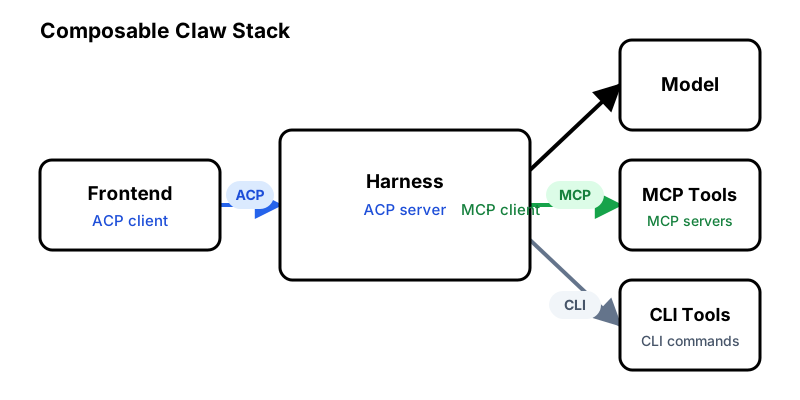
The harness can be wrapped in a container for sandboxing and network isolation.
Here is my stack:
- Model: GPT-5.6 (Sol and Luna), Qwen3.8-27B
- Harness: Pi, with pi-acp, pi-mcp-adapter
- Instructions: AGENTS.md
-
Tools:
- CLIs: gog, leda, matrix-commander
- MCPs: mcp-cron, chrome-devtools-mcp, mnemosyne
- Clients: matrix-acp-bridge, mcp-cron
- Network isolation: squid
- Sandboxing: Docker
To run multiple profiles, copy the same stack and update the instructions and tools for each one.
Think it is too much to configure? We have a tool for that!
Example Multi-profile Docker Compose Setup